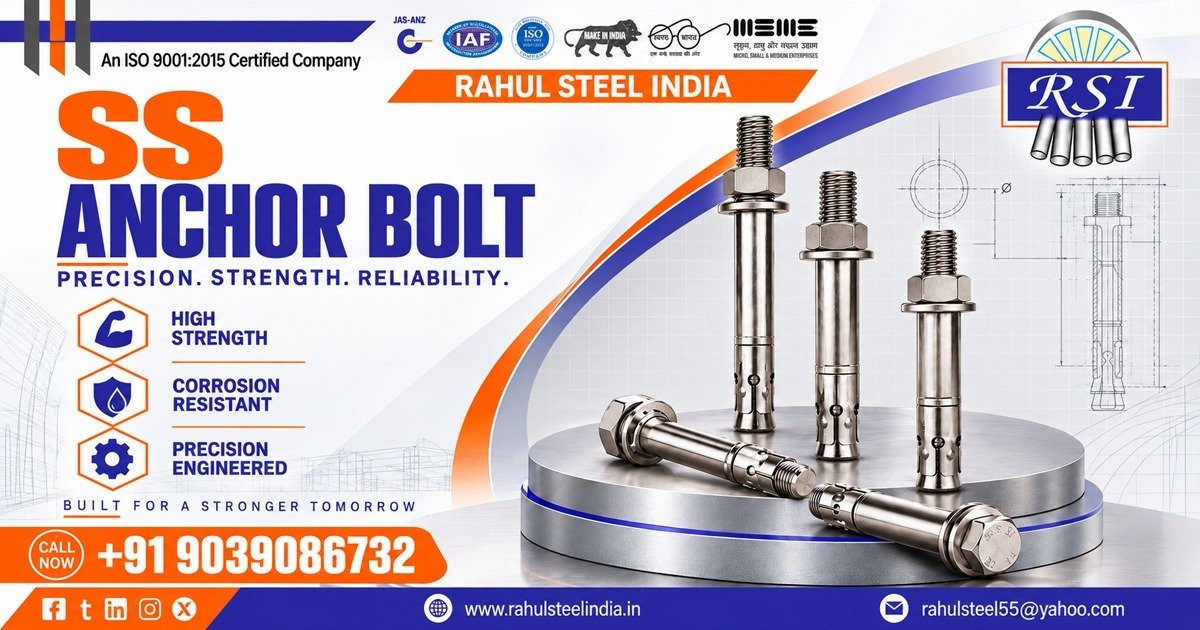
Industrial foundations, equipment supports, and structural connections require fastening solutions matched to load, environment, and installation conditions. A Stainless Steel Anchor Bolt Supplier In Madhya Pradesh such as Rahul Steel India can help buyers plan suitable anchoring requirements for different projects.
Where Anchor Bolts Fit Into Industrial Construction
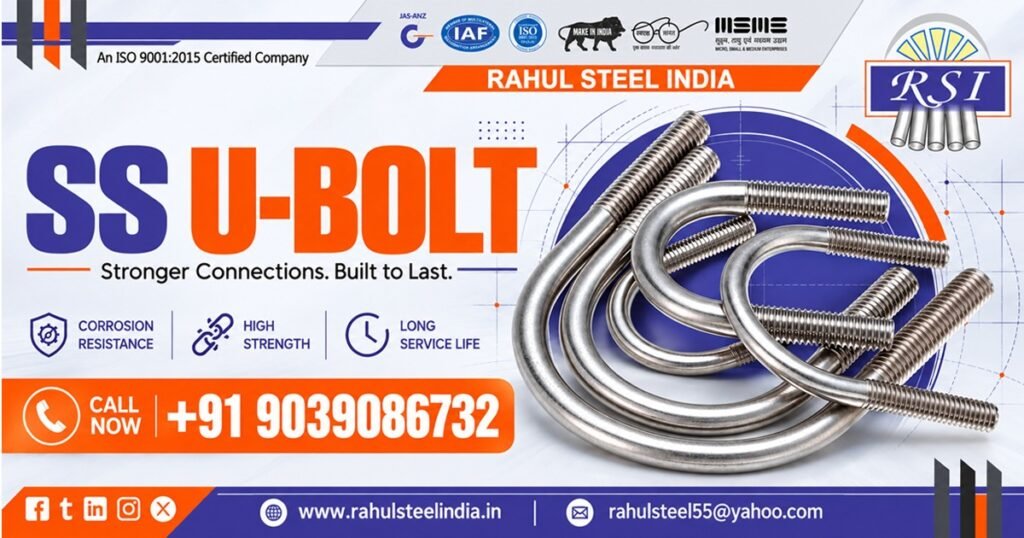
Anchor bolts are used to connect structural or equipment components securely to concrete foundations or other supporting structures. Stainless steel versions can be considered where corrosion resistance is an important requirement.
Typical requirements may include:
- Equipment and machinery foundations
- Structural steel connections
- Industrial sheds and support structures
- Pipe racks and utility supports
- Fabricated platforms
- Chemical and process plant structures
- Outdoor construction projects
- Infrastructure and engineering installations
The exact anchor-bolt arrangement depends on the foundation design, connected structure, load conditions, and project drawings.
What Buyers Should Finalize Before Requesting a Quote
A supplier can prepare a more suitable quotation when the requirement is clearly defined. Buyers should provide as much technical information as possible.
Important details include:
| Requirement | What to Confirm |
| Bolt diameter | Required nominal diameter |
| Overall length | Based on foundation and connection design |
| Thread | Thread type, pitch, and threaded length |
| Material | Required stainless steel grade |
| Quantity | Total bolts and project-wise requirement |
| Shape | Straight, bent, L-type, J-type, or drawing-specific |
| End configuration | Threaded or project-specific arrangement |
| Application | Equipment, structure, foundation, or support |
| Drawing | Approved drawing or sample, where available |
For project-specific anchor bolts, drawings and dimensional details should be checked before manufacturing or procurement.
Material Selection Depends on the Installation Environment
Stainless steel should not be selected only because the project requires a corrosion-resistant material. The actual operating environment also matters.
Before placing an order, evaluate:
- Exposure to moisture or outdoor conditions
- Chemical contact
- Temperature conditions
- Required mechanical properties
- Contact with dissimilar metals
- Cleaning or washing conditions
- Expected service environment
- Project specifications
The required stainless steel grade should be confirmed against the engineering specification and application. A supplier should not substitute a different grade simply because the dimensions appear similar.
Getting the Bolt Geometry Right for the Foundation
Anchor-bolt dimensions have a direct relationship with the foundation and connected equipment. A mismatch can create installation difficulties even when the material itself is suitable.
Check these points before production:
- Bolt diameter – Confirm against the approved design.
- Overall length – Account for embedment and connection requirements.
- Threaded portion – Verify available thread length and nut engagement.
- Bolt shape – Match the foundation and equipment arrangement.
- Bolt spacing – Follow the equipment or structural drawing.
- Projection – Ensure the exposed threaded section suits the final assembly.
- Hole or template position – Verify alignment before installation.
Installation Planning Starts Before the Concrete Work
A practical sequence is:
1 – Review the drawing
Confirm bolt positions, dimensions, orientation, and foundation requirements.
2 – Prepare the positioning arrangement
Use the approved template or positioning method to maintain the required spacing.
3 – Position the bolts
Place the bolts according to the project layout and check their alignment.
4 – Verify before final fixing
Measure spacing, projection, verticality, and location before the foundation reaches the stage where correction becomes difficult.
5 – Complete installation
Follow the project engineer’s approved foundation and fastening procedure.
6 – Final inspection
Check the installed bolt pattern against the drawing before mounting the equipment or structure.
Actual embedment, tightening requirements, foundation dimensions, and installation tolerances should follow the approved engineering documents.
Checks That Can Prevent Procurement Problems
Before accepting the material, verify:
- Quantity received
- Bolt diameter and length
- Shape and configuration
- Thread condition
- Surface condition
- Material specification
- Nut and washer compatibility, where supplied
- Packaging and identification
- Drawing or purchase-order conformity
- Available material or test documentation, if specified
For bulk industrial orders, checking a sample from each relevant batch or delivery lot can help identify dimensional discrepancies before installation begins.
Routine Checks After Installation
Look for:
- Visible corrosion or surface deterioration
- Loose nuts or fastening components
- Damaged threads
- Signs of movement around the connection
- Cracks or deterioration around the foundation
- Misalignment of connected equipment
- Changes in the condition of exposed fasteners
If a structural or equipment connection shows abnormal movement, the responsible engineer or maintenance team should investigate the underlying cause rather than simply tightening the fastener without assessment.
Common Anchor-Bolt Issues and Practical Checks
| Common Issue | Possible Cause | Practical Check |
| Bolt does not align with equipment holes | Incorrect positioning or drawing mismatch | Compare installed positions with the approved layout |
| Nut does not engage properly | Thread damage or incorrect thread details | Inspect thread condition and verify specification |
| Bolt projection is insufficient | Incorrect length or installation position | Compare projection with the assembly requirement |
| Visible corrosion | Unsuitable material or environmental exposure | Review material grade and operating conditions |
| Equipment mounting is difficult | Foundation or bolt-position mismatch | Recheck foundation and equipment drawings |
| Fastener appears loose | Installation or connection issue | Have the assembly inspected according to the approved procedure |
How to Evaluate a Stainless Steel Anchor Bolt Supplier
Ask the supplier:
- Can the bolt be supplied according to a drawing?
- What material specification will be followed?
- Can dimensions be confirmed before production?
- Are nuts and washers available if required?
- How will the products be identified and packed?
- What documentation is available?
- Can project quantities be handled consistently?
- What support is available if dimensional clarification is required?
A clear purchase specification reduces the chance of receiving a product that looks correct but does not match the actual installation requirement.
Services
- Requirement assessment based on application, dimensions, and project drawings
- Product selection and specification coordination for stainless steel fastening requirements
- Manufacturing and supply coordination for project and bulk requirements
- Technical and after-sales assistance for product-related queries
Location
Madhya Pradesh has diverse industrial and commercial centres where stainless steel fastening products may be required for construction, engineering, fabrication, infrastructure, and plant projects. Relevant locations include Indore, Bhopal, Jabalpur, Gwalior, Ujjain, Sagar, Dewas, Satna, Ratlam, Rewa, Katni, Singrauli, Pithampur, Mandideep, Malanpur, Nagda, Khandwa, Burhanpur, Chhindwara, Vidisha, Sehore, Neemuch, Mandsaur, Dhar, and Morena.
Planning Industrial Fastener Requirements With Rahul Steel India
Rahul Steel India works with stainless steel and industrial metal products, including SS fasteners and fabrication-related requirements. Its website identifies its operating and manufacturing base in Raipur, Chhattisgarh, and lists stainless steel fasteners among its raw-material product range.
For buyers in Madhya Pradesh, the requirement can be discussed around:
- Required bolt configuration
- Material and grade requirements
- Dimensions and quantities
- Drawing-based or project-specific requirements
- Supply planning and technical coordination
The supplied project brief also specifies manufacturing support from Ahmedabad, Gujarat, India. Buyers can use Rahul Steel India’s website to review the company and submit their requirement. The company website currently identifies Raipur as its principal location, with Ahmedabad listed among its branches.
Frequently Asked Questions
Q: What information should I provide when ordering stainless steel anchor bolts?
A: Provide diameter, overall length, thread details, bolt shape, material requirement, quantity, application, and drawing details where available. These details help avoid dimensional mismatches.
Q: How should I select the stainless steel grade for anchor bolts?
A: Grade selection depends on the installation environment, corrosion exposure, mechanical requirements, temperature, and project specification. Confirm the required grade before ordering.
Q: What should be checked when anchor bolts arrive at the site?
A: Check quantity, diameter, length, shape, thread condition, material identification, surface condition, and conformity with the purchase order or approved drawing before installation.
Conclusion
Selecting a Stainless Steel Anchor Bolt Supplier In Madhya Pradesh requires more than comparing prices. Buyers should verify material, dimensions, bolt geometry, foundation requirements, documentation, and project compatibility. Rahul Steel India can support requirement coordination, with its documented manufacturing base in Raipur and the supplied brief identifying additional Ahmedabad support.
Contact Rahul Steel India to discuss your stainless steel anchor bolt dimensions, material requirements, quantities, drawings, and project-specific fastening needs.
Call Us: +91 99818 48646 / +91 90390 86732 / +91 9770084041
Email: rahulsteel55@yahoo.com | inforsi646@gmail.com