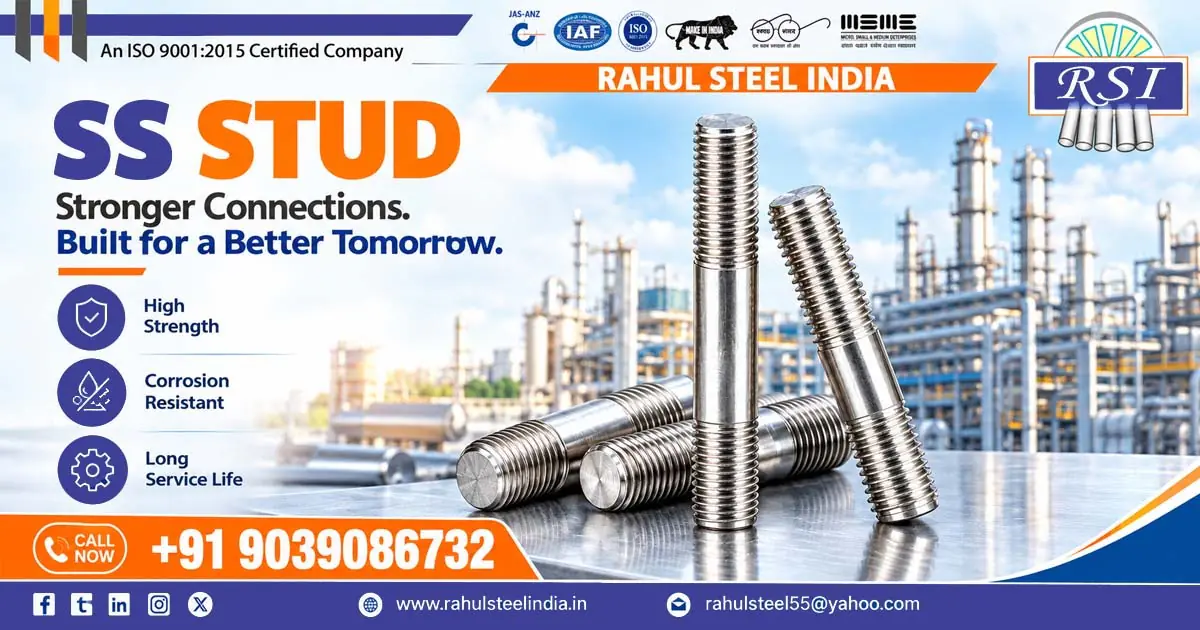
Finding a suitable Stainless Steel Stud Supplier In Odisha requires more than checking availability. Buyers need to match stud material, dimensions, threading, application conditions, and supply support with the actual fastening requirement.
Where Stainless Steel Studs Fit Into Industrial Assemblies
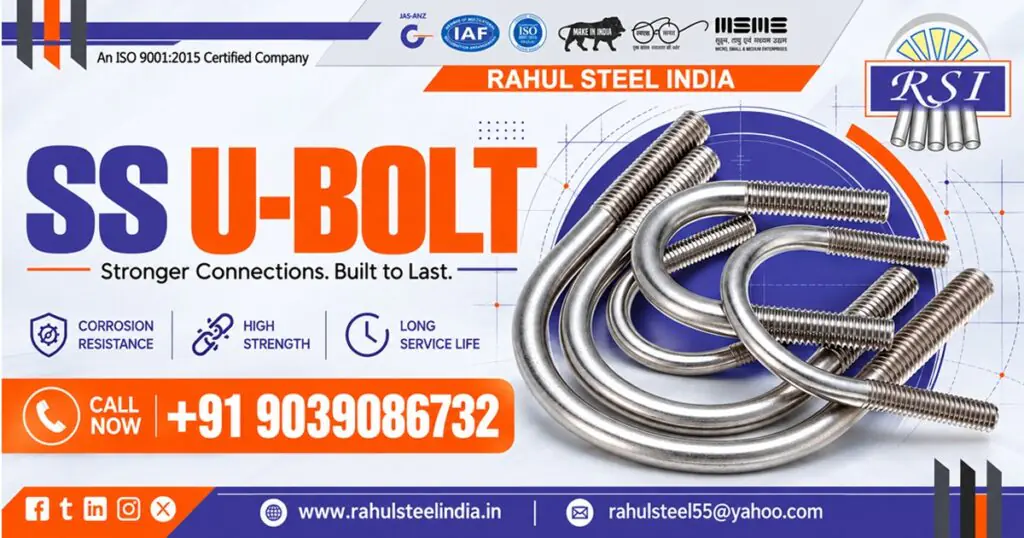
A stainless steel stud is a threaded fastening component used where secure joining, repeated assembly, or resistance to demanding environments is required.
Unlike a conventional bolt-and-nut arrangement, a stud can remain installed in one component while the mating part is secured using a nut.
Common industrial requirements include:
- Equipment and machinery assemblies
- Flange and piping connections
- Fabricated structures
- Maintenance and replacement work
- Process equipment
- General industrial fastening
- Areas where corrosion resistance is a consideration
The correct stud should match the joint design rather than being selected only by diameter or price.
What Buyers Should Confirm Before Selecting a Stud
The right choice depends mainly on the joint configuration, material requirement, dimensions, and operating environment.
| Selection factor | Why it matters |
| Stud diameter | Must suit the mating hole and joint requirement |
| Thread type | Ensures compatibility with the nut and assembly |
| Length | Determines proper engagement without unnecessary projection |
| Stainless steel grade | Should suit the environmental and application conditions |
| Thread quality | Affects fitting, tightening, and serviceability |
| Surface condition | Helps identify manufacturing or handling issues |
| Quantity | Supports proper procurement and spare planning |
For replacement orders, buyers should compare the existing stud dimensions with drawings or previously approved specifications before placing a bulk order.
Material Choice Should Match the Working Environment
Stainless steel is available in different grades, and the grade should be selected according to the service conditions rather than simply choosing stainless steel as a generic category.
Consider:
- Exposure to moisture or corrosive surroundings
- Contact with process materials
- Temperature conditions
- Indoor or outdoor installation
- Required mechanical properties
- Compatibility with mating components
If the application has specific material requirements, the purchaser should communicate the required grade clearly to the supplier. This reduces the possibility of receiving a dimensionally correct component made from an unsuitable material.
Dimensional Checks That Prevent Assembly Problems
A stud may appear simple, but small dimensional differences can create installation difficulties.
Before ordering, verify:
- Overall length – Confirm the required threaded and unthreaded portions.
- Diameter – Match the stud diameter with the assembly design.
- Thread pitch – Ensure compatibility with the intended nut.
- Thread length – Check engagement requirements at both ends where applicable.
- End condition – Confirm whether the application requires a particular end configuration.
- Quantity tolerance – Establish acceptable dimensional variation for the order.
For repeat procurement, maintaining an approved dimensional specification can make future purchasing faster and reduce mismatched replacement parts.
How to Check Stud Quality During Procurement
A practical incoming inspection can identify many issues before the components reach the production floor.
Buyers can check:
- Material grade against the purchase requirement
- Diameter and overall length
- Thread condition
- Nut compatibility
- Surface finish and visible defects
- Quantity supplied
- Packaging condition
- Required inspection or material documentation, where applicable
Threads should be checked carefully for damage, deformation, burrs, or contamination. For critical assemblies, inspection requirements should be agreed with the supplier before production or dispatch.
Maintenance and Replacement Checks
Stainless steel studs generally require straightforward inspection, but their condition can affect the integrity of the complete joint.
During maintenance, check for:
- Damaged or worn threads
- Corrosion or surface deterioration
- Loose fastening
- Deformation
- Signs of incorrect installation
- Damage to the mating nut or component
Replace components when their condition no longer meets the assembly requirement. For frequently serviced equipment, keeping identified replacement sizes in stock can reduce maintenance delays.
Evaluating a Stainless Steel Stud Supplier In Odisha
Supplier selection should cover both the product and the purchasing process.
Before placing an order, ask:
- Can the supplier provide the required dimensions and material grade?
- Can specifications be confirmed before manufacturing or supply?
- Are customized dimensions possible when standard sizes do not fit?
- What inspection or documentation can accompany the order?
- How are components packed for transportation?
- Is technical clarification available before ordering?
- Can repeat requirements be handled using an approved specification?
For buyers in Odisha, local delivery requirements and project schedules should also be discussed early, particularly when studs are required alongside other fabricated or mechanical components.
Services
- Requirement assessment based on stud dimensions, application, and quantity
- Product selection support for material grade and fastening requirements
- Customized supply planning for non-standard dimensional requirements
- Technical assistance for repeat orders and replacement requirements
Location
Industrial projects across Odisha may require stainless steel fastening components for fabrication, maintenance, piping, machinery, and infrastructure work. Supplier coordination is particularly useful when buyers need consistent dimensions and material requirements across repeated orders. Relevant locations include Bhubaneswar, Cuttack, Rourkela, Angul, Jharsuguda, Sambalpur, Balasore, Berhampur, Paradeep, Dhenkanal, Jajpur, Kalinganagar, Rayagada, Koraput, Baripada, Bhadrak, Puri, Keonjhar, Talcher, Sundargarh, Bargarh, Kendrapara, Jagatsinghpur, and Khordha.
Product Planning Support From Rahul Steel India
Rahul Steel India can assist industrial buyers with understanding fastening requirements, checking product dimensions, and planning stainless steel stud supplies according to project needs. Buyers can discuss their required size, material grade, quantity, and application before ordering.
The company website, rahulsteelindia.in, can be used to review its product and business information. Manufacturing support is provided from its unit in Raipur, Chhattisgarh, India, giving buyers a point of coordination for industrial requirements.
FAQ
Q: How should I select the correct stainless steel stud size?
A: Confirm the required diameter, overall length, thread type, pitch, and thread engagement from the equipment drawing or existing assembly before ordering.
Q: Can stainless steel studs be supplied in customized dimensions?
A: Customized dimensions may be considered when standard sizes do not suit the application. Share the required dimensions and quantity with the supplier for confirmation.
Q: What should be checked when receiving stainless steel studs?
A: Check material details, dimensions, thread condition, quantity, surface condition, and any agreed inspection or documentation requirements.
Q: Is technical support useful for repeat stud purchases?
A: Yes. Keeping an approved specification for size, grade, thread, quantity, and application can simplify repeat procurement and reduce the risk of incompatible replacements.
Conclusion
Selecting a stainless steel stud requires attention to material, thread compatibility, dimensions, joint design, and service conditions. Buyers across Odisha can evaluate these factors before ordering and coordinate requirements with Rahul Steel India, supported by manufacturing facilities in Raipur, Chhattisgarh.
Call Us: +91 99818 48646 / +91 90390 86732 / +91 9770084041
Email: rahulsteel55@yahoo.com | inforsi646@gmail.com