
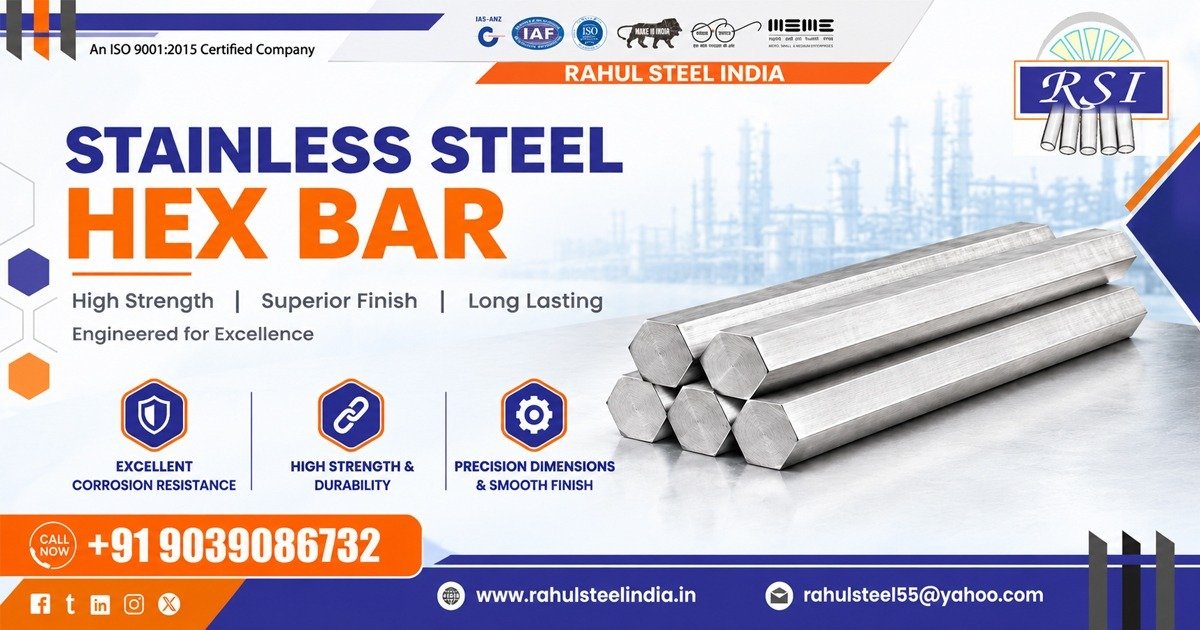
Stainless Steel Hex Bar Supplier In Rajasthan searches often come from buyers who need dependable material dimensions, suitable grades, and consistent machining performance. Rahul Steel India supports industrial requirements with manufacturing support from its unit in Raipur, Chhattisgarh, India.
How Hexagonal Steel Bars Fit Into Precision Manufacturing
Stainless steel hex bars have a six-sided cross-section that provides convenient gripping surfaces for machining and fastening applications. Their geometry makes them useful when components require flats for wrench engagement or need to be machined into specific shapes.
Common applications include:
– Fasteners, nuts, bolts, and threaded components.
– Valve parts, fittings, and industrial connectors.
– Machined components for engineering equipment.
– Fabricated parts used in industrial assemblies.
The appropriate bar depends on the component design, required mechanical properties, corrosion exposure, and manufacturing process.
What Buyers Should Check Before Finalising a Bar Size
Selecting a hex bar involves more than matching the nominal dimension. Small variations in size or material properties can affect machining, assembly, and finished-component consistency.
Before requesting a quotation, establish the following details:
– Across-flats dimension: Confirm the required distance between opposite flat surfaces.
– Material grade: Select a grade according to corrosion exposure, strength requirements, and machining needs.
– Bar length: Specify standard or required cut lengths to manage material usage and production planning.
– Surface condition: Identify acceptable surface marks, scale, or finish requirements based on the final application.
– Quantity: Share the expected order quantity and future demand to support procurement planning.
A clear specification reduces the risk of receiving material that requires additional processing or does not fit the intended component design.
Matching Stainless Steel Grades to Operating Conditions
Stainless steel grades differ in corrosion resistance, mechanical properties, and machinability. The correct choice depends on the working environment rather than the material name alone.
For example, a component exposed to moisture or cleaning chemicals may need a different grade from a general-purpose machined fitting. Components exposed to higher mechanical loads also require appropriate verification of their specified material properties.
Buyers should confirm:
– The exact grade required by the drawing or purchase specification.
– Exposure to moisture, chemicals, temperature changes, or outdoor conditions.
– Machining operations such as turning, drilling, threading, and cutting.
– Any specified mechanical or chemical composition requirements.
Avoid substituting one grade for another based only on appearance or price. Verify the suitability of the alternative before approving the purchase.
From Raw Bar Stock to a Finished Component
Hexagonal bar stock generally passes through several manufacturing stages before becoming a finished industrial component.
Step 1 – Material Verification
Check the grade, dimensions, and available material documentation against the purchase order.
Step 2 – Cutting to Length
Cut the bar according to the component drawing and machining allowance.
Step 3 – Machining
Depending on the design, operations may include turning, drilling, threading, milling, or other material-removal processes.
Step 4 – Component Inspection
Measure the finished dimensions, check threads where applicable, and inspect the surface for defects relevant to the application.
Step 5 – Assembly or Dispatch
Release the component for assembly or the next production stage after the required checks are completed.
Starting with correctly specified material helps reduce avoidable machining adjustments and material wastage.
Quality Checks That Matter During Procurement
Material quality should be verified before the bars enter production. This is particularly relevant when multiple batches are used for the same component or when dimensional consistency affects assembly.
Use this checklist during incoming inspection:
– Compare the delivered dimensions with the purchase order.
– Verify grade identification and traceability documentation where required.
– Check the bar surface for visible cracks, dents, or other unacceptable defects.
– Confirm straightness and length against the agreed specification.
– Review material test certificates when they are part of the purchase requirement.
– Ensure the supplied quantity and packaging match the order.
Acceptance criteria should be agreed upon before dispatch, especially for precision-machined components and critical industrial assemblies.
Installation, Storage, and Routine Material Handling
Hex bars are raw material rather than installed equipment, so proper storage and handling help preserve their condition until machining begins.
For better material management:
– Store bars on suitable racks or supports to minimise bending and accidental damage.
– Separate different grades and sizes to prevent material mix-ups.
– Keep identification labels and relevant documents linked to each batch.
– Protect the material from contamination and unnecessary exposure to corrosive substances.
– Use appropriate lifting and handling equipment for heavy bundles.
During machining, follow the machine manufacturer’s operating and safety instructions. Maintain suitable cutting conditions and tooling for the selected stainless steel grade.
Troubleshooting Common Material and Machining Issues
Some production problems originate from incorrect material selection, unsuitable tooling, or insufficient incoming inspection.
| Common issue | Possible cause | Practical check |
| Bar does not fit the intended fixture | Incorrect across-flats dimension | Re-measure the bar against the drawing |
| Excessive tool wear | Grade or machining conditions are unsuitable | Review material identification, tooling, and cutting parameters |
| Surface defects after machining | Existing damage or unsuitable handling | Inspect the raw stock and handling practices |
| Finished components vary in size | Inconsistent machining or material dimensions | Check incoming measurements and process settings |
| Corrosion appears during service | Grade or environmental compatibility issue | Review the operating environment and specified grade |
If a material defect is suspected, segregate the affected batch and consult the supplier or quality team before using it in production.
Industrial Material Supply Planning With Rahul Steel India
For buyers searching for a Stainless Steel Hex Bar Supplier In Rajasthan, supplier discussions should cover the required grade, dimensions, quantity, documentation, and intended application before an order is confirmed.
Rahul Steel India provides industrial steel supply support through its website, rahulsteelindia.in. Its stated manufacturing support is from a unit in Raipur, Chhattisgarh, India; buyers should confirm the availability of the specific grade, size, and length required for their project.
When evaluating a supplier, clarify:
– Whether the requested material specification can be supplied.
– What dimensional and material documentation is available.
– How the order quantity and dispatch requirements will be handled.
– Whether the quotation clearly identifies the grade, size, and commercial terms.
These checks help procurement teams compare quotations on a like-for-like basis rather than making decisions on price alone.
Services
– Stainless steel material requirement assessment.
– Assistance with grade and dimensional specification review.
– Order quantity and procurement planning coordination.
– Material documentation and supply requirement clarification.
Location
Industrial buyers across Rajasthan may require stainless steel hex bars for engineering, machining, fabrication, and maintenance activities. Relevant commercial and industrial locations include Jaipur, Jodhpur, Udaipur, Kota, Ajmer, Bhiwadi, Alwar, Neemrana, Banswara, Bhilwara, Pali, Kishangarh, Sikar, Sri Ganganagar, Hanumangarh, Chittorgarh, Beawar, Barmer, Jaisalmer, Bharatpur, Dholpur, Abu Road, Jhalawar, and the Sitapura Industrial Area.
Frequently Asked Questions
Q: How do I select the correct stainless steel hex bar size?
A: Check the across-flats dimension, required length, machining allowance, and finished-component drawing. Confirm dimensional tolerances with the supplier before ordering.
Q: Which stainless steel grade should I specify for hex bars?
A: The grade depends on corrosion exposure, mechanical requirements, and machining needs. Share the operating conditions and component specification before confirming the material.
Q: What documents should I request when purchasing hex bars?
A: Depending on the application, request material identification, dimensional details, and material test certificates or traceability records where specified by your quality requirements.
Q: Can buyers in Rajasthan source hex bars from a supplier based outside the state?
A: Yes. Buyers can evaluate suppliers outside Rajasthan by confirming material availability, specifications, documentation, dispatch arrangements, and commercial terms before placing an order.
Conclusion
Correct grade selection, dimensional verification, and suitable storage help buyers obtain stainless steel hex bars that meet their machining and assembly requirements. Businesses across Rajasthan can discuss their specifications with Rahul Steel India and review supply options supported by its Raipur, Chhattisgarh, manufacturing unit.
Contact Rahul Steel India through rahulsteelindia.in to discuss your stainless steel hex bar requirements, confirm material specifications, and plan procurement for your project.
Call Us: +91 99818 48646 / +91 90390 86732 / +91 9770084041
Email: rahulsteel55@yahoo.com | inforsi646@gmail.com


